How We Built the 2026-27 College Basketball Preseason Rankings
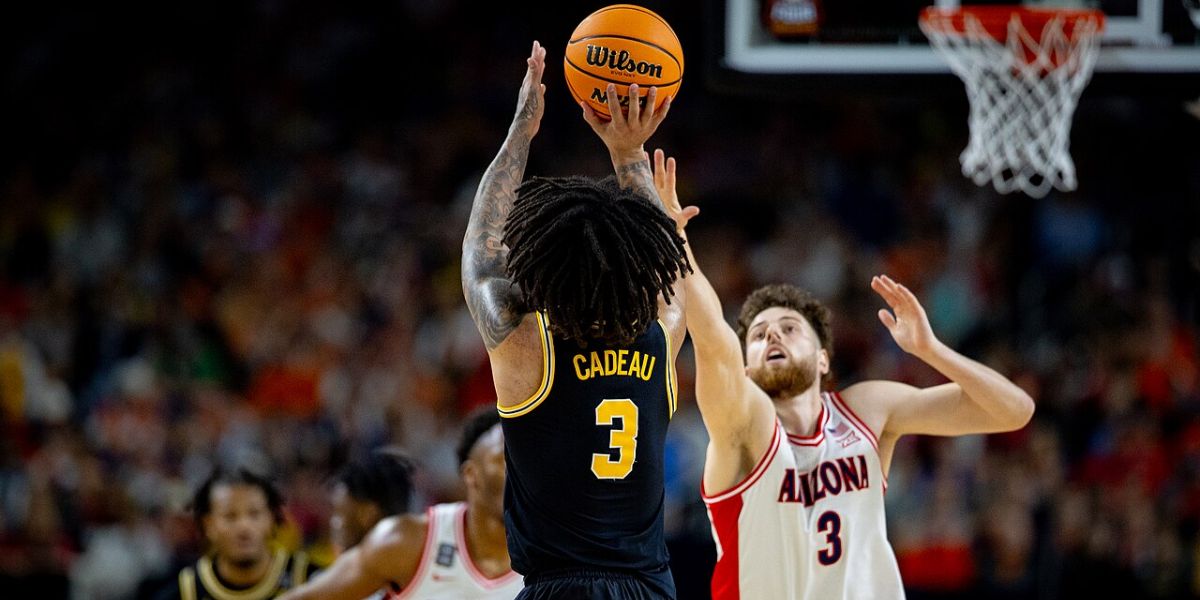
Michigan won the national title last season and opens 2026-27 at No. 5 in our rankings. Arizona is No. 1, with Duke and UConn right behind. And the reason Michigan isn't on top is pretty simple: it lost four starters and its head coach, and the freshman it was counting on tore his ACL in August.
Here's how our preseason board for men's college basketball comes together, which teams we moved by hand and why, and the full top 25.
Where Preseason College Basketball Ratings Start
Every team starts from where it finished last season. That's all 1,068 men's teams in Divisions I, II and III, rated on the same scale. But a full season doesn't carry over whole, so every team gets pulled 20 percent of the way back toward the average of its own division.
That 20 percent comes from our own history. We compared each Division I team's final rating to its final rating the next year across nine pairs of seasons, and about 85 to 90 percent of a team's strength survived the offseason. Defense carried over a little better than offense. Then we checked how well last season's ratings predicted the first 400 games of the next season, and the answer kept landing near 80 percent. So we keep 80 percent and give up the rest.
How Much a Preseason Board Matters for Picking Winners
We replayed the first six weeks of ten seasons, almost 20,000 Division I games, to see whether the way we build the preseason board actually changes who we pick to win. It barely does. Carrying last season forward picked 14,477 winners. The board we built in past years, which blended in outside preseason numbers, picked 14,492. That's 15 games out of 19,689.
And every one of those differences came in the first two weeks. From week three on, every version picked the exact same winners, because by then the games themselves are doing the work. So a preseason board has a short job. It has to be sensible for about two weeks, and then it has to get out of the way.
The Eight Teams We Adjusted
Every roster changes in the transfer portal era, and the 80 percent carry-over already accounts for a normal amount of turnover. So we only moved a team by hand when its offseason was clearly outside normal and we could check the facts. Eight teams met that bar. Each adjustment is in points of scoring margin, and the total comes back out of the rest of Division I evenly, so the board as a whole doesn't get any better or worse.
- Michigan, -7 points. Yaxel Lendeborg, Morez Johnson Jr., Aday Mara and Nimari Burnett are gone, and so is coach Dusty May, who left for the Dallas Mavericks. Mike Boynton was promoted to replace him. And freshman Brandon McCoy Jr. tore his ACL on the team's summer tour and will miss the season.
- Purdue, -6 points. Braden Smith, Fletcher Loyer, Trey Kaufman-Renn and Oscar Cluff are all gone. Only about 40 percent of last season's minutes come back.
- Utah State, -4 points. Coach Jerrod Calhoun left for Cincinnati, Ben Jacobson replaced him, and only about a quarter of last season's minutes return. But Mason Falslev, the Mountain West Player of the Year, is back, and he's the main reason this isn't bigger.
- Wisconsin, -4 points. The two guards who carried the offense are gone. Nick Boyd ran out of eligibility, and John Blackwell transferred to Duke.
- Nebraska, -3 points. Rienk Mast, Sam Hoiberg and Jamarques Lawrence used up their eligibility, and Mast was the go-to scorer up front. But Pryce Sandfort, first-team All-Big Ten last season, is back, and so is Braden Frager, the league's Sixth Man of the Year.
- Florida, +2 points. Florida brings back more of its rotation than anybody in our top 25: Thomas Haugh, Alex Condon, Boogie Fland, Rueben Chinyelu and Urban Klavzar. A roster that intact deserves more than the standard 80 percent.
- Texas, +2 points. Almost nobody returns, but the transfers coming in look about as good as the players who left, and they added a top-five freshman. Honestly this is the one I'm least sure about.
- USC, +5 points. This is the biggest move up. Rodney Rice averaged 20.3 points but played only six games before a shoulder injury, and Alijah Arenas missed the first 18 games. Both are back. So last season's 18-14 record was mostly built without USC's two best players.
Michigan still lands at No. 5 after its adjustment, which tells you how good last season's team was. Purdue drops from fifth at the end of last season to 25th. USC climbs from 65th to 32nd.
The 2026-27 Preseason Top 25
This is our Division I board going into opening night, with each team's record and final rank from last season. It's frozen at today's date, and the live college basketball rankings will start moving away from it as soon as games are played.
- Arizona (36-3, finished 2nd)
- Duke (35-3, 3rd)
- UConn (34-6, 4th)
- Florida (27-8, 8th)
- Michigan (37-3, 1st)
- Houston (30-7, 6th)
- St. John's (30-7, 7th)
- Illinois (28-9, 10th)
- Michigan State (27-8, 9th)
- Arkansas (28-9, 11th)
- Iowa State (29-8, 12th)
- Virginia (30-6, 13th)
- Alabama (25-10, 14th)
- Gonzaga (31-4, 16th)
- Kansas (24-11, 17th)
- Vanderbilt (27-9, 18th)
- Tennessee (25-12, 19th)
- Texas Tech (23-11, 20th)
- North Carolina (24-9, 23rd)
- Nebraska (28-7, 15th)
- UCLA (24-12, 24th)
- Villanova (24-9, 25th)
- BYU (23-12, 26th)
- Louisville (24-11, 27th)
- Purdue (30-9, 5th)
Division II and Division III Preseason Rankings
The small colleges get the same treatment, each pulled toward its own division's average. Gannon opens No. 1 in Division II, ahead of Nova Southeastern and Washburn. Mary Washington is No. 1 in Division III, followed by Emory and Trinity (CT). We didn't adjust any Division II or III teams by hand. The full lists are in the Division II rankings and Division III rankings.
How Long Preseason Ratings Last
Once games start, the preseason rating works as an anchor that gets weaker every week. It counts for a lot in November, when a team has played three games and a 3-0 record doesn't mean much. By the end of December it's gone completely, and from then on the ratings come only from games played. So expect the board to move fast in the first two weeks.
The college basketball game predictions built off these ratings are already up for opening week, which starts with the first small-college games on October 30 and the big Division I opening night on November 2.
Frequently Asked Questions
How are college basketball preseason rankings calculated?
Ours start from each team's final rating from last season, pull every team 20 percent of the way back toward its division's average, and then adjust a small number of teams by hand for offseason changes far outside normal, such as losing most of a rotation or a head coach. Once games start, the preseason rating fades out completely by the end of December.
Who is the best college basketball team going into 2026-27?
Arizona, by our preseason ratings, with Duke second and UConn third. Florida is fourth, and defending national champion Michigan is fifth after losing four starters and head coach Dusty May.
How much of last season carries over in college basketball?
About 85 to 90 percent of a Division I team's strength survives into the next season, measured across nine pairs of seasons, and defense carries over slightly better than offense. Last season's ratings predicted the next season's early games best when kept at about 80 percent strength.
Are college basketball rankings free?
Ours are free for every men's team in Divisions I, II and III, along with team ratings and team summaries. Game predictions and the game simulator are part of a Versus premium membership.
Please note that some links in this article may be sponsored or contain affiliate content.

Steve Pugh, Founder and CEO, Compughter Technologies, LLC
Steve Pugh, the founder of Versus Sports Simulator, is passionate about the world of sports analytics and statistical modeling. With a deep-rooted love for math and sports, and a commitment to innovation, he's dedicated to equipping sports enthusiasts with useful tools and insights to help them make informed betting decisions.